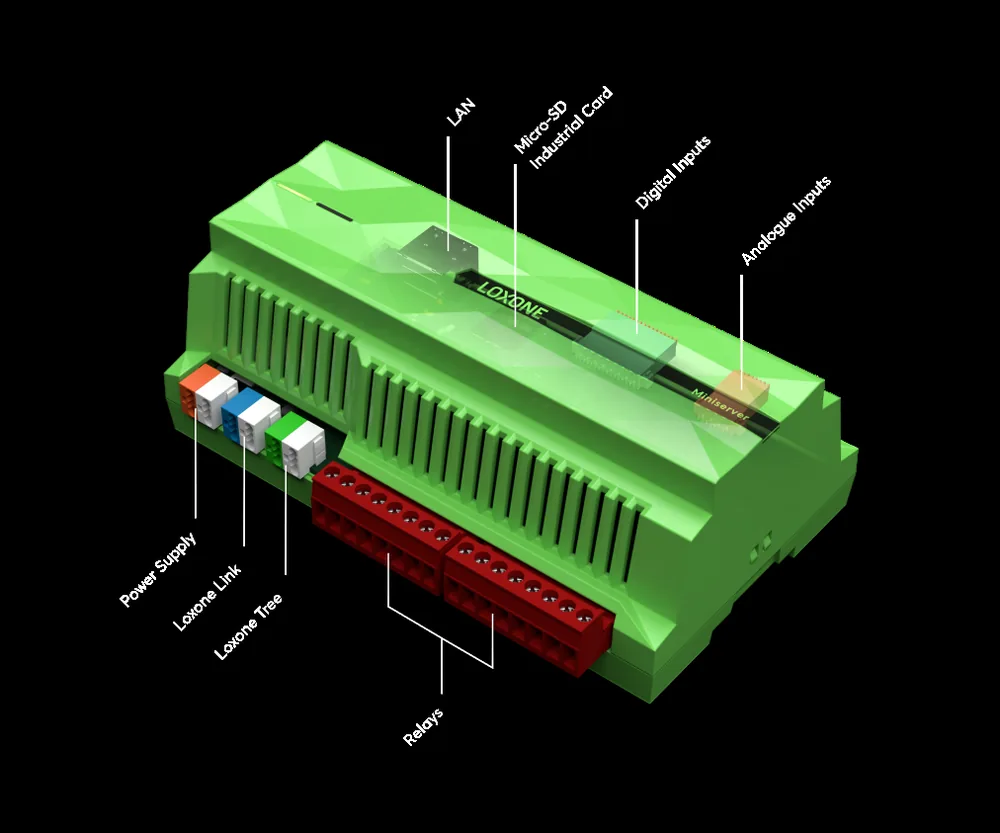
Loxone field layer
Loxone Tree, Air and 1-Wire — Choosing the Field Layer
A practical guide to Loxone Tree, Air and 1-Wire: where each field layer fits, what constrains it, and how to choose per zone.
Quick answer
Tree is the wired field bus, Air is the wireless path, and 1-Wire is a low-speed sensor bus. Tree suits new-build rooms and plant where cable can be planned; Air suits retrofit and hard-to-cable spaces; 1-Wire suits temperature probes and simple sensors. Most projects use at least two of the three, chosen zone by zone.
Tree: one cable, addressed devices
Tree is a wired bus that carries power and data to devices such as presence sensors, touch controls, dimmers and valves. Devices are addressed, so a single run can serve a chain of room controls rather than a home run for every switch. That reduces cable volume and makes the panel smaller, but it shifts discipline to the field: topology, termination, device addresses and a clear as-built drawing. Tree is strongest in new-build rooms, plant rooms and risers where the cable route can be designed before ceilings close. It is a poor fit for a retrofit where the route is unknown and the ceiling must stay intact. Draw the route before the first cable is pulled; a sketch made on site is not a topology, and it will not survive the ceiling closing.
- Power and data on the same cable
- Address devices before commissioning starts
- Keep the as-built route drawing current
Air: wireless where cable is the constraint
Air is a wireless link for sensors, controls and actuators. It is useful in refurbishments, heritage interiors, rented space and any room where chasing walls would cost more than the device. Wireless does not remove engineering: radio path, interference, battery replacement, pairing and device ownership all need a plan. Batteries are a maintenance item, not a commissioning detail, and the building's IT or security team may have views about radio use. Use Air where it solves a real constraint, not as a substitute for thinking about the cable route. If the building has a wireless policy, apply it from the start; adding a radio network after handover is harder than agreeing one before installation, and the device list will have changed.
- Plan the radio path before fixing devices
- Record battery type and replacement cycle
- Agree radio use with IT and security
1-Wire: simple sensing, not control
1-Wire is a low-speed bus for small sensors, most commonly temperature probes on pipes, tanks and plant. It is inexpensive and easy to extend, which makes it attractive for plant-room monitoring, frost protection and metering support. It is not a general control bus: it is slow, electrically simple and intended for sensing. Keep 1-Wire segments short and documented, label each probe, and record the conversion or offset used. A temperature reading is only useful if the next engineer knows which pipe it belongs to. The same discipline applies to any simple sensor bus: label, record and keep the segment plan with the panel schedule, not only in the installer's notebook or a photograph on someone's phone.
- Use it for probes, not for sequences
- Label every sensor at the pipe
- Record offsets and conversion factors
Choosing by zone, not by ideology
The right answer is usually a mix. A new-build hotel may use Tree in guest rooms, 1-Wire in the plant room and Air for a few retrofit corridors. A heritage villa may use Air almost everywhere and 1-Wire where cable is easy. A plant room may use wired fieldbus for deterministic control and 1-Wire for monitoring. Decide zone by zone, record the choice and its reason in the design, and keep the field layer consistent within each zone. Consistency reduces spares, training and commissioning errors. The worst outcome is a different field layer in every room because no one wrote the rule down; the second worst is one layer stretched beyond its physical limits.
- One field layer per zone where practical
- Record the reason for each choice
- Standardise spares and training by layer
Loxone Air and 1-Wire in practice
Loxone Air is the wireless field layer for rooms where cabling is impractical: retrofit apartments, heritage ceilings, moving partitions and occupied spaces. Plan device density and battery replacement access before commissioning. Loxone 1-Wire is a separate low-speed bus for temperature sensors and identity devices; it is useful for plant, risers and metering points where a simple two-wire run is more practical than a controller per floor. Neither layer replaces a wired backbone for high-density I/O. Use them where the building geometry or retrofit constraints make them the lower-risk option, and document the radio plan and bus topology in the handover pack.
Field layer comparison
6 rows| Layer | Typical use | Constraint to design for |
|---|---|---|
| Tree | Room controls, presence sensors, dimmers and valves on planned cable routes | Topology, termination, addressing and as-built drawings |
| Air | Retrofit rooms, heritage interiors and hard-to-cable spaces | Radio path, interference, batteries and pairing records |
| 1-Wire | Pipe, tank and plant temperature sensing | Segment length, labelling and sensor offsets |
| KNX | Third-party lighting, shading and room control | ETS project ownership and group-address discipline |
| RS485 / Modbus | Meters, inverters and plant equipment | Termination, polling budget and register mapping |
| Dry contact | Legacy equipment, fire signals and simple status | Voltage, isolation and fail-safe state |
Project images
3 images

Frequently asked
01Can Tree and Air be mixed on one project?
Yes. The controller supports both, and most buildings benefit from choosing per zone. Keep the logic and naming consistent even when the physical layer differs.
02Is Air reliable in concrete buildings?
Radio behaves differently in concrete, steel and dense occupancy. A site survey and a fallback plan are more useful than a generic range claim, especially for safety-related or critical points.
03Does Tree need a separate power supply?
Tree carries power and data, but the segment still has a power budget. The controller and extension ratings determine how many devices can share a segment, so the budget should be calculated rather than assumed.
04Can 1-Wire be used for control?
It is intended for simple sensing. Use a fieldbus or controller I/O for outputs and safety-related sequences, and keep 1-Wire for temperature and similar measurements.
05Can we reuse existing KNX or RS485 cabling?
Sometimes, subject to topology, insulation and ownership. Test before committing; old cable is not automatically a working network, and undocumented modifications may have changed its characteristics.
Next step
Bring us the building.
Tell us the building type, systems in scope and the outcome you need. We will map the shortest path to a working system.