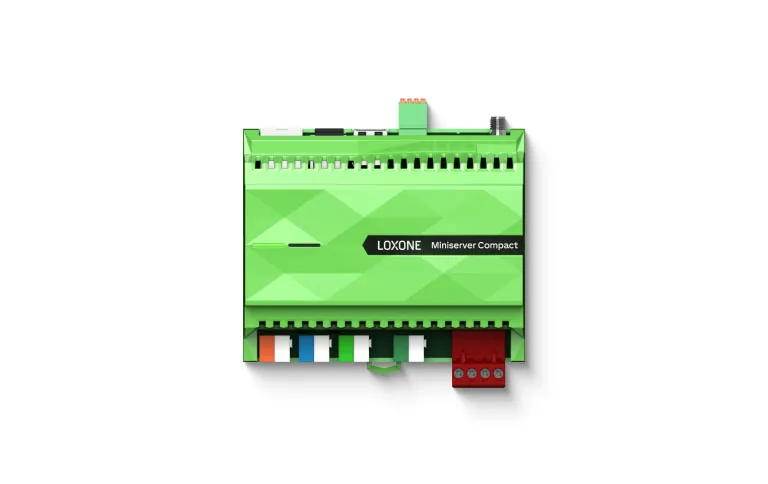
Loxone system
Loxone Miniserver Guide — Core Controller, Extensions and Capacity
How the Miniserver fits into a Loxone installation, how extensions and multiple controllers scale a project, and how to plan capacity before panels are built.
Quick answer
A Miniserver is the local controller at the centre of a Loxone installation. It runs schedules, sequences and interlocks on site, holds the project configuration, and connects extension modules, Tree and Air devices and third-party systems. Capacity is planned per controller and per building zone rather than by a single headline figure.
What the controller actually owns
A Miniserver is not a router with relays. It is the computer that holds the building's control logic: schedules, setpoints, sequences, interlocks, alarm rules and trend collection. Because that logic runs locally, the building keeps working when the internet connection, the cloud service or the head-end PC is unavailable. The project file is the single source of truth for the site, so version control, backups and a documented change process matter as much as the hardware choice. Think of the Miniserver as the owner of local behaviour, not as a dashboard server. That ownership also clarifies the boundary with the app and the network: the controller decides, the interfaces present. A sequence that depends on a cloud service is not a local behaviour and should be documented as an exception.
- Runs time programmes, logic and interlocks on site
- Keeps operating during WAN or cloud outages
- Stores the project file and device configuration
Extending rather than overloading
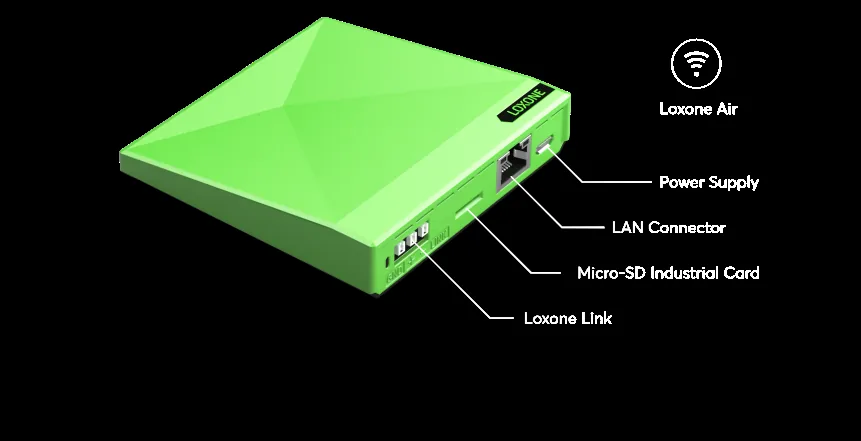
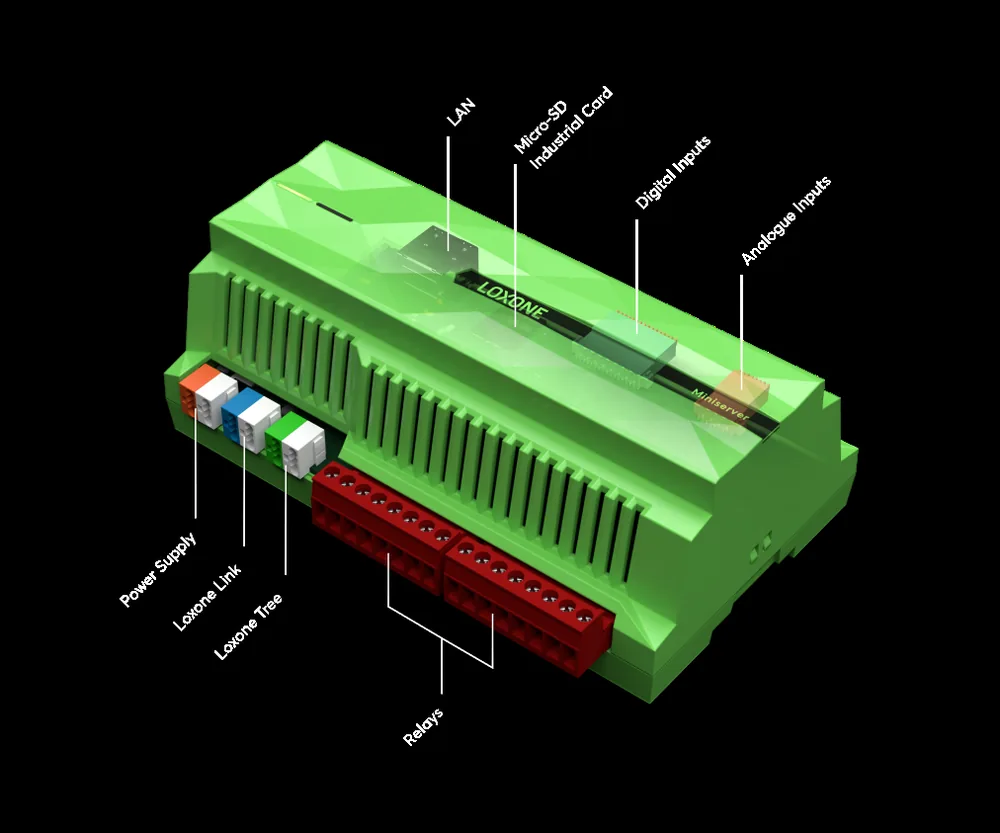
Loxone installations scale by adding controllers and extension modules, not by stretching one device across an entire building. Extension modules add physical inputs, outputs, relays or dimming channels and connect over Loxone Link. Tree extensions provide the wired field bus; Air extends the system wirelessly; 1-Wire handles simple sensors. On larger sites, several Miniservers are distributed by riser, floor, tenant or plant area, then supervised as one system. This keeps wiring runs short, limits the blast radius of a fault, and makes each controller's point list small enough to test and maintain. The design should also state which controller is the master for shared data such as outdoor temperature or time, so two devices do not publish conflicting values to the same point.
- Extensions add I/O close to the field devices
- Multiple controllers can serve one building
- Distribution follows risers, floors or tenancies
Capacity planning that survives handover
Capacity is more than input and output counts. A useful schedule records physical I/O, bus devices, logic and visualisation load, network addresses, power budget, enclosure space and spare terminals. The design should leave headroom for the changes every building acquires after occupation: a new door, a meter, a tenant fit-out. It should also record which controller owns which sequence, so a future engineer does not have to reverse-engineer the site. If the point schedule and the controller allocation are produced during design, commissioning becomes a verification exercise rather than a discovery exercise. A simple rule is to size for the building as handed over and then add a defined margin that the owner can see in the schedule, not one hidden in a panel.
- Count I/O, bus devices, logic and network load
- Reserve spare capacity for post-handover changes
- Record controller ownership for every sequence
Specifying and handing over
Specify the Miniserver by role, not by model name alone: what it controls, where it sits, how it is powered, how it is backed up and who may change it. Require a network diagram, an address schedule, a backup before handover and a restore test. Remote access should be a documented decision, not an accidental open port. Firmware and software versions belong in the handover pack, together with the project file and a change log. The test is simple: can another competent engineer open the project, understand it, and make a small change without calling the original installer? That test is also a strong defence against a project that works only on the original engineer's laptop, with no documented route back into the building.
- Document role, location, power and network
- Test backup and restore before handover
- Hand over the project file, versions and change log
Miniserver capacity planning dimensions
6 rows| Dimension | What to record | Why it matters |
|---|---|---|
| Physical I/O | Inputs, outputs, relays and analogue channels per controller | Prevents last-minute extensions and overloaded panels |
| Field bus | Tree devices, Air devices and 1-Wire sensors per segment | Keeps each segment testable and within its power budget |
| Logic load | Schedules, sequences, interlocks and alarm rules | Makes performance and change impact visible |
| Network | IP addresses, VLANs and remote access paths | Supports segmentation and reliable remote support |
| Power and enclosure | Supply budget, terminal space and DIN rail capacity | Avoids crowded panels and heat problems |
| Spare capacity | Free terminals, addresses and controller headroom | Covers post-handover changes without redesign |
Project images
3 images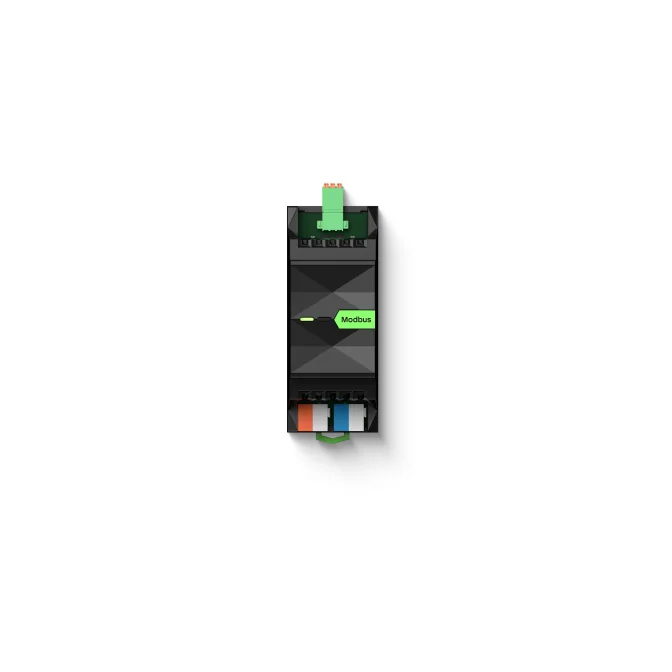
Frequently asked
01Does every building need more than one Miniserver?
Not necessarily. A single controller can serve a compact building or a clearly bounded zone. Distribution becomes useful when cable runs, point counts, fault tolerance or tenant separation make one controller awkward.
02What happens when the internet connection fails?
Local schedules, sequences and interlocks continue to run on the Miniserver. Remote app access and cloud reporting stop until connectivity returns, which is a very different outcome from a cloud-dependent system.
03Are extension modules required for third-party integration?
No. Third-party systems connect through network interfaces, gateways or native protocol support. Extensions are mainly for physical I/O and field devices, not for every integration.
04Can one Miniserver manage several floors?
It can, if wiring, point count and failure impact stay acceptable. Many projects distribute controllers by floor or riser so that a fault affects one area and commissioning can proceed zone by zone.
05How should spare capacity be specified?
Specify it as a percentage of used points or as a fixed number of free terminals and addresses, and state it in the point schedule. The important thing is that the number is agreed before panels are built.
Next step
Bring us the building.
Tell us the building type, systems in scope and the outcome you need. We will map the shortest path to a working system.