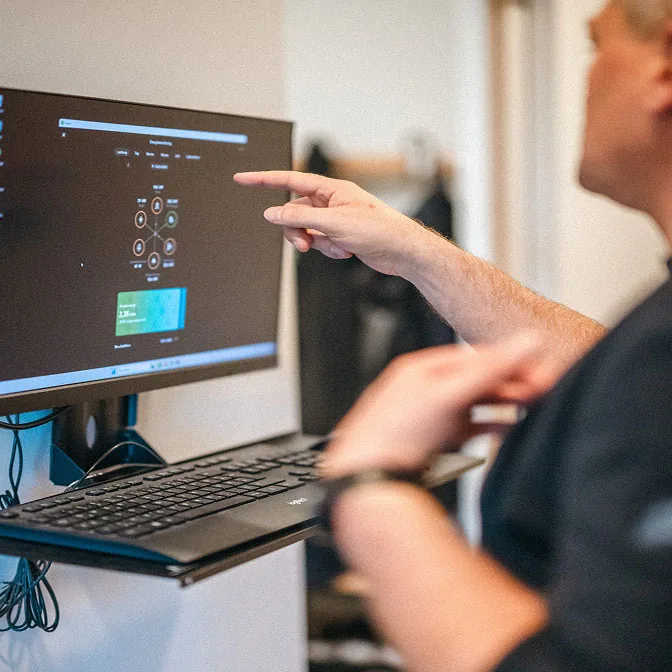
Panel build
From Panel Drawing to Site Commissioning
How our panel build process works: selection, panel design, assembly, wiring, factory acceptance testing, documentation, packing and site commissioning.
Selection and engineering
Every panel starts with the point schedule, not the enclosure. We review the sequences, the I/O count, the protocol interfaces and the physical layout, then select controllers, extension modules, power supplies, terminals and field devices against the project specification. The output is a bill of materials, a controller loading plan and a list of assumptions that the client can challenge before assembly begins. Where the design is still moving, spare capacity and spare terminals are agreed explicitly rather than left to chance. The aim is a panel that can be built once, tested properly and maintained by someone other than the person who wired it. The same discipline applies whether the panel is a single enclosure or a suite of linked assemblies. Selection is reviewed against the point schedule line by line, and any unresolved item is recorded as an open query rather than absorbed into the build.
- Point schedule and sequences reviewed before selection
- Controller loading and spare capacity agreed explicitly
- Bill of materials and assumptions issued for comment
Panel design and layout
Panel drawings define the arrangement before anyone drills a hole. General arrangement, power distribution, control schematics, terminal schedules and labelling conventions are produced and reviewed. Segregation between mains and extra-low-voltage wiring, thermal clearance, cable entry, access for maintenance and the position of the HMI are decided at this stage. The design follows the project's electrical standards and the applicable local requirements; where a client standard exists, it takes precedence. The drawing set is a controlled document, so a change on the workshop floor is reflected in the issued drawing rather than remembered by the installer. The design review is a hold point: assembly does not start until the drawing set and the bill of materials are released, and the release is recorded with a revision number that follows the panel through testing and handover.
- General arrangement, schematics and terminal schedules
- Mains and extra-low-voltage wiring segregated
- Maintenance access and HMI position designed in
- Client standards take precedence where they exist
Incoming inspection and component control
Components are checked against the purchase order and the approved bill of materials on arrival. Packaging damage, model designation, voltage rating, firmware version and quantity are recorded. Components that carry a calibration or test document are logged with the document reference. Rejected items are quarantined and marked, not returned to the shelf. Where a substitute is proposed, it is reviewed for electrical compatibility, terminal spacing and firmware support before it is accepted. Incoming inspection is unglamorous, but it is cheaper than discovering a wrong relay coil or a missing interface card during factory testing. The inspection record becomes part of the quality file and should be traceable to the panel serial number and the project it belongs to, so that a component question can be answered months later. The record should also note the storage location, because a component held in stock for a long time may need a functional check before it is fitted.
- Every delivery checked against the approved bill of materials
- Model, rating, firmware and quantity recorded
- Rejected items quarantined and traceable
- Substitutions reviewed before acceptance
Assembly and wiring
Assembly takes place in our workshop, with the drawings, the bill of materials and the terminal schedule at hand. Components are mounted, cables are cut to length, conductors are ferruled and labelled, and terminals are torqued to the specified value. Wiring is routed to keep power and signal separated and to leave room for maintenance. Continuity, insulation and point-to-point checks are recorded as the panel is built, not discovered later on site. Work in progress is inspected against the drawing at defined stages, and any deviation is marked up for the as-built record. The wiring review is a second hold point: no panel goes to configuration until the point-to-point sheets are complete and every deviation has been either corrected or formally accepted. Cable routes should be photographed before the trunking cover goes on, since the photograph often answers a question the drawing cannot.
- Components mounted to the reviewed drawing
- Conductors ferruled, labelled and terminated to torque
- Continuity, insulation and point-to-point checks recorded
- Stage inspections with deviations marked for as-built
Configuration and software quality
Configuration turns a wired panel into a control system. Controller programmes, graphics, schedules, alarm texts and user rights are built from the reviewed sequence description. Naming follows the project convention so that a point on the drawing, the terminal schedule and the screen carry the same identifier. Software is backed up at defined milestones, and each backup carries a version, a date and a note describing what changed. Simulation tests logic before power is applied to real equipment, but it does not replace point checks. The configuration review is a third hold point: the alarm list, the schedule list and the user roles are checked against the specification before factory testing begins. A programme that works but cannot be read by the next engineer is only half delivered. Where a client supplies a naming standard, the configuration adopts it directly rather than translating it into a local convention.
- Programme built from the reviewed sequence description
- One naming convention across drawing, terminals and screens
- Backups carry version, date and change note
- Alarm, schedule and user-role review before FAT
Factory acceptance testing
Factory acceptance testing is the point where the panel proves itself before it ships. Power is applied, controllers boot, I/O is simulated, and each sequence is exercised against the point schedule. Alarms, interlocks, fail-safe states and communication links are tested, and the results are recorded against the test specification. The client or consultant is invited to witness the test and to raise comments while the panel is still in the workshop. Faults are corrected, retested and signed off. A FAT report, marked-up drawings, configuration backups and a punch list leave with the panel; the punch list is closed before site commissioning starts. Every test result should reference the sequence or point it proves, so that a later reviewer can reconstruct what was tested and what was not. The test environment should be described in the report, including which simulated signals replaced field devices.
- Simulated I/O and sequence testing against the point schedule
- Alarms, interlocks and fail-safe states verified
- Client or consultant witness invited
- FAT report and punch list issued with the panel
Documentation, packing and handover
Documentation is part of the product: as-built drawings, terminal schedules, point lists, configuration backups, operating instructions and maintenance information. Panels are cleaned, protected, labelled and packed for transport, with fragile items and loose components identified. On site, installation is checked against the drawing before power is applied. Site acceptance testing repeats the critical checks with real field devices, including loops, sensors, actuators and interfaces to third-party systems. Operators are trained on the interface and the alarm response. Handover is complete when the documentation, the test records, the backups and the training record are accepted. The document register should state the revision of every item, because a folder of undated files is not a handover, it is a liability with a cover page. The handover meeting should end with a signed document register, not a promise to send the remaining files later.
- As-built drawings, point lists and configuration backups
- Panels cleaned, protected and labelled for transport
- Site acceptance testing with real field devices
- Operator training and signed handover record
Panel build stages, QA gates and evidence
14 rows| Stage | Key output | QA gate or hold point | Acceptance evidence |
|---|---|---|---|
| Point schedule review | Agreed I/O count, sequences and interfaces | Open queries closed before selection | Reviewed point schedule with revision |
| Selection and engineering | Bill of materials, controller loading, assumptions | Design package reviewed with the client | Released BOM and assumption list |
| Panel design | GA drawing, schematics, terminal schedule | Drawing release hold point | Approved drawing set with revision |
| Incoming inspection | Verified components | Reject and quarantine rule applied | Incoming inspection record |
| Substitution review | Approved alternative where needed | Electrical and firmware compatibility checked | Substitution approval note |
| Mechanical assembly | Mounted components and labelled wiring | Stage inspection against the drawing | Stage inspection record |
| Wiring and termination | Ferrules, labels and torqued terminals | Torque and labelling check | Termination checklist |
| Point-to-point checks | Continuity, insulation and point records | Wiring review hold point | Completed point-to-point sheets |
| Configuration | Controller programme, graphics and alarms | Naming and sequence review | Configuration review record |
| Software baseline | Versioned backup before test | Backup completeness check | Backup register with version and date |
| FAT | Simulated I/O and sequence testing | Punch list closed before shipment | Signed FAT report and punch list |
| Packing and transport | Protected and labelled panels | Packing check and photo record | Packing list and loading record |
| Site installation check | Panel installed as drawn | Power-on hold point | Installation check sheet |
| SAT and handover | Loop checks, training and records | Open items closed or accepted | Signed SAT and handover record |
Project images
3 images

Frequently asked
01Do you build to our drawings?
Yes. We review the drawings and point schedule, then build to the client's standard. Where the documents conflict, we issue a query list and agree the change before assembly rather than altering the drawing on the workshop floor. The query list and its resolutions stay with the project file, so the as-built record explains why a detail differs from the original issue.
02Do you offer OEM or ODM panel build?
Yes. Panels, controls and programming can be delivered under the client's brand and documentation format. The boundary, intellectual property and warranty responsibilities are written into the contract. The client's document templates and naming rules are applied from the first drawing, because retrofitting a house style at handover usually leaves inconsistencies that nobody has time to fix.
03What is FAT?
Factory acceptance testing. Before shipment, simulated or real signals verify I/O, sequences, alarms and communications, and the results are recorded. It keeps problems in the workshop instead of carrying them to site. The test should follow a written script linked to the point schedule, and every deviation should be closed or accepted with a named owner.
04Can we attend the FAT?
Yes, by project arrangement. The client or consultant can witness, question and sign off. Remote witnessing is possible, but critical sequences are still preferably confirmed in person. If the test is remote, the camera should be able to show the panel, the terminal and the screen at the same time, and the test script should be shared beforehand.
05What documentation comes with a panel?
As-built drawings, terminal schedules, point lists, configuration backups, test reports, operating instructions and maintenance information. The exact package is agreed in the contract annex. Every document should carry a revision and a date, and the register should identify who approved it, so that the building team can tell a current drawing from a superseded one.
06How are panels packed for transport?
Panels are cleaned, protected against moisture and dust, labelled and packed, with fragile items and loose components secured separately and listed. Export or sea freight follows the agreed packing level. Photographs of the packed panel are taken before dispatch, because transport damage is easier to resolve when the condition at loading is documented.
07Who carries out site commissioning?
Our engineers or a trained local installation team, depending on location and scope. Site readiness, network availability and third-party interfaces should be confirmed before the commissioning window opens. A short readiness checklist sent two weeks ahead prevents the most common delay: a panel that is ready and a site that is not.
08Which standards documentation accompanies a panel?
Design and testing follow the project specification and the applicable standards named in it. The panel file records the drawings, the inspection and test plan, the test results and any approved deviations. Where the project requires third-party inspection or local documentation, it is arranged through the contract rather than assumed to be part of a standard package.
Next step
Bring us the building.
Tell us the building type, systems in scope and the outcome you need. We will map the shortest path to a working system.