Hotel guest room control has a simple brief: the room should be comfortable when the guest is there, efficient when they are not, and invisible in between. Most projects achieve two of the three.
The difference is usually not the hardware. It is the specification: what the room controller owns, how the PMS interacts, what the guest can override, and what the operator can see after handover.
The room as a system
A modern guest room contains lighting, shading, HVAC, door access, service requests, minibar or occupancy sensing, and sometimes AV. The room controller (RCU) coordinates them locally. The building platform supervises the portfolio.
That division matters. The room should keep working if the central network is down. The central platform should still know what happened when it comes back.
Specify the room modes
Most guest room control failures come from undefined modes. A practical specification defines at least:
- Welcome: triggered by check-in or first entry; lighting scene, comfortable temperature, curtains open.
- Occupied: guest in the room; comfort limits apply, service requests active.
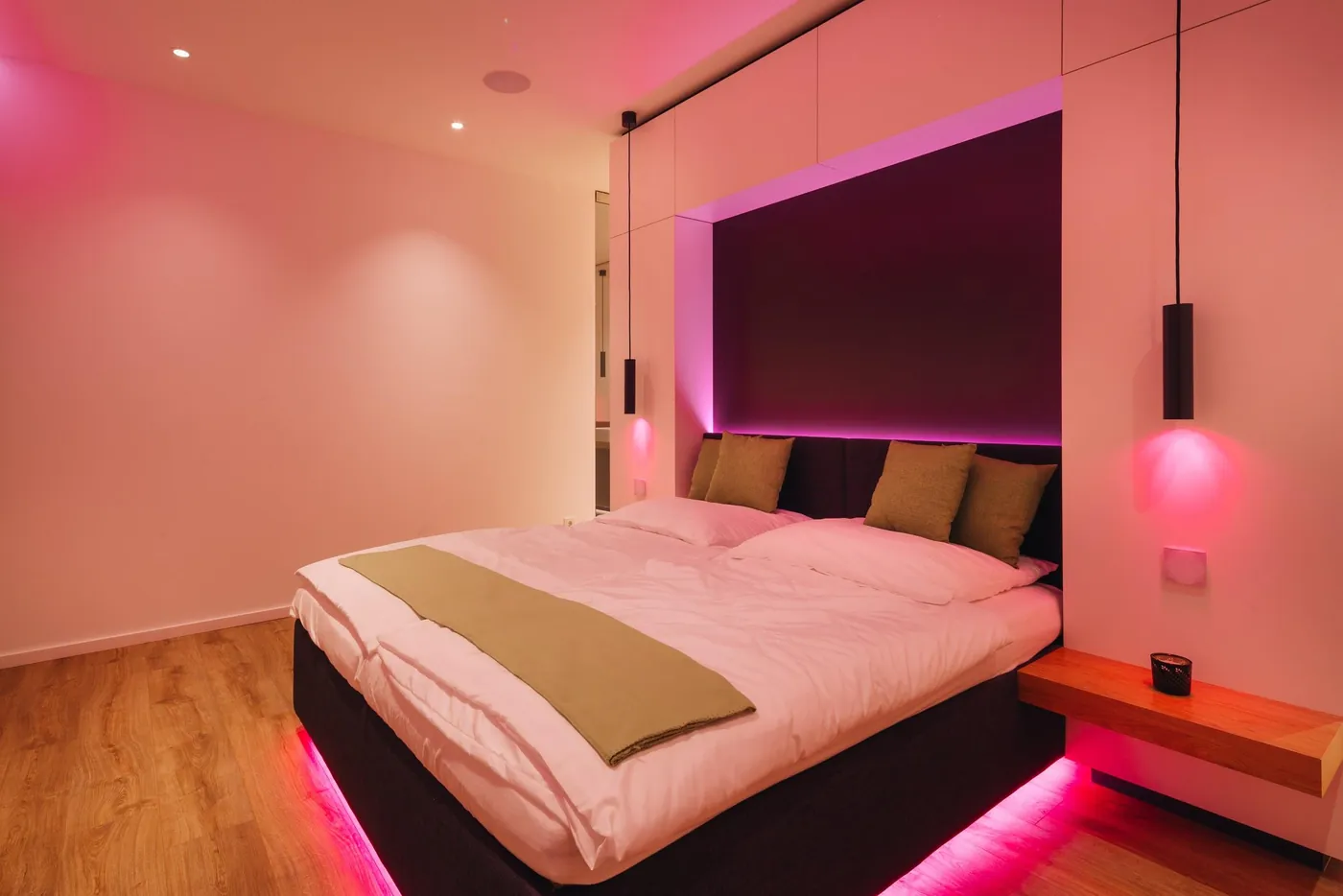
- Sleep: night scene, reduced lighting, quieter HVAC, do-not-disturb logic.
- Unoccupied: guest out; energy-safe temperature band, lighting off, ventilation reduced.
- Deep clean / maintenance: staff mode with full lighting and disabled guest overrides.
Each mode should define the lighting scene, HVAC setpoint, shading position, ventilation state and which overrides remain available.
PMS integration: events, not screenshots
The PMS integration should exchange events, not scrape screens. Check-in, check-out, room move and VIP status are the useful signals. The room controller uses them to set the initial mode; the platform uses them to report room state.
Write down what happens when the PMS is unavailable. The room should default to a safe local mode, and the platform should raise a clear alarm rather than silently guessing.
Guest overrides
Guests should be able to adjust comfort within limits. The limits should be explicit: a temperature band, a maximum fan speed at night, a maximum lighting level after a certain hour. Overrides should expire when the room becomes unoccupied.
A guest should never have to read a manual to turn on the shower light. If the interface needs explaining, the scene design is not finished.
Energy without discomfort
Room-level energy savings come from a small number of measures: unoccupied temperature bands, ventilation reducing when the room is empty, lighting following presence, and shading responding to sun and privacy. None of these require the guest to feel a compromise.
Measure them separately. A room-level meter and a clear baseline let the operator see whether the control strategy is working, and where the outliers are.
What to put in the handover
| Deliverable | Why it matters |
|---|---|
| Room mode matrix | Defines the behaviour everyone is commissioning against. |
| Point schedule by room type | Makes repeatable rooms actually repeatable. |
| PMS event map | Shows which events drive which room states. |
| Override policy | Prevents guest comfort and energy targets from fighting silently. |
| Room-level baseline | Turns energy claims into measured performance. |
The takeaway
Guest room control is a specification problem before it is a technology problem. Define the modes, define the PMS events, define the overrides and define the handover. The technology is mature; the clarity is not.