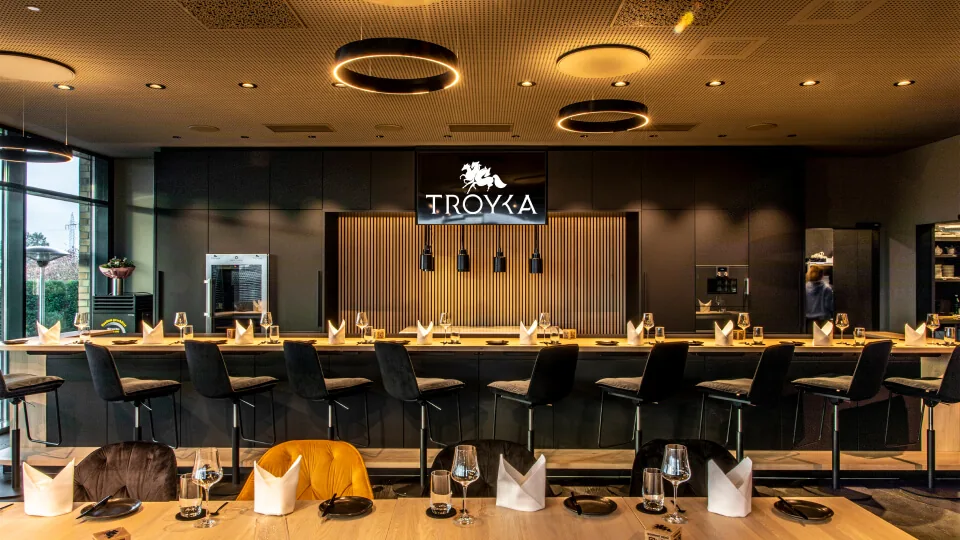
Hospitality
Hotel Room Control
How guest room control coordinates lighting, HVAC, shading, access and PMS events, and what to specify for a repeatable room.
The room as a small building
A guest room contains the same systems as a building, compressed into a few square metres: lighting circuits, HVAC terminal, shading, door access, service requests, sometimes AV and minibar sensing. The room controller coordinates them locally. The building platform supervises the portfolio. That division is the design: the room must remain usable when the central network is unavailable, and the platform must know what happened when it returns. A room that depends on a remote server to turn on a light is not a finished design. The same principle applies to every device in the room: local control first, supervision second, and a documented fallback for every network failure. The room is also the smallest repeatable unit in the project, which makes it the clearest place to prove the template before it is copied to hundreds of rooms. A mock-up room is cheaper than a floor of rework. The mock-up should use the same controller, keypad and sensor models as the production rooms.
- Lighting scenes and local switches
- Fan-coil, underfloor or radiant terminal
- Curtains, sheers and external shading
- Door contact, access event and service request
Room modes and the mode matrix
Define the modes before choosing the keypad. A practical set is welcome, occupied, sleep, unoccupied and housekeeping. Each mode should state the lighting scene, temperature band, fan behaviour, shading position and which guest overrides remain active. Welcome can be triggered by check-in or first entry; sleep reduces lighting and fan noise; unoccupied widens the temperature band and closes the valves. Housekeeping needs full light and disabled guest limits. The mode matrix is the single source of truth for the room: it should be reviewed by operations, engineering and the interior designer, because it encodes comfort policy as much as control logic. If the modes are ambiguous, the room will behave differently on every floor. Define the transitions as well as the states: what happens on check-out, on a door opening, on a window opening, on a fire alarm. Define the override policy: how long a guest command lasts and what cancels it. A mode matrix that fits on one page is easier to enforce.
- Welcome, occupied, sleep, unoccupied
- Housekeeping and maintenance mode
- Scene, setpoint, fan and shading per mode
- Transitions and override policy
HVAC, lighting and shading together
Comfort is a combination, not a thermostat. Solar gain through an open curtain changes the cooling load; a dark room with the air conditioning at full speed feels wrong. The room controller should coordinate shading with HVAC and lighting: close the sheer before the sun loads the room, reduce fan speed at night, raise lighting only when presence is confirmed. Guest controls stay simple: warmer, cooler, brighter, darker, open, close. The logic behind them can be sophisticated; the interface should not be. Window contacts should suspend heating or cooling, and a door contact should restore the occupied mode without waiting for the guest to find a panel. The aim is comfort inside an energy envelope. Use a deadband around the setpoint so that valves and fans do not hunt, and staged fan speeds rather than a single on/off output. Test the interaction between shading, solar gain and cooling at different times of day. Commissioning should include a solar-gain test on a sunny day, not only a night test.
- Shading before solar gain, not after
- Fan speed limits at night
- Presence-based lighting and ventilation
- Simple guest controls over complex logic
PMS integration and the operator view
PMS integration should exchange events, not screenshots: check-in, check-out, room move and VIP status. Those events set the room mode and update the front-desk view. Where the PMS supports it, room status and service requests can be written back. The integration must define what happens when the PMS is unavailable: the room falls back to a safe local mode, and the platform raises a clear alarm instead of guessing. Housekeeping and maintenance need a separate view, not the guest interface. The event map should be documented like a point schedule, with the event name, direction, timing and the room state it changes. A PMS integration that only works when the network is perfect is not an integration. Decide whether the room controller or the PMS is the authority for occupancy. Avoid polling the PMS for room status when an event interface exists. Log every event and every write-back with a timestamp. The event map should state what happens when an event arrives twice.
- Check-in, check-out, room move, VIP
- Room status and service requests back to PMS
- Safe local fallback when PMS is offline
- Housekeeping and maintenance views
- Event map with direction and timing
Points per room, templates and naming
Point count follows the room type, not a rule of thumb. Every lighting circuit, dimmer channel, sensor, valve output, fan speed, curtain relay, door contact, thermostat and service-request input is a point. A standard room with combined lighting and a simple fan-coil has fewer points than a suite with separate zones, motorised sheers, bathroom scenes and a terrace. A typical planning range for a standard hotel room is roughly 20 to 40 controlled points, with suites higher; confirm it against the room-type schedule rather than adopting the number. The room-type schedule should repeat exactly from floor to floor, and the handover pack should include the mode matrix, point schedule, PMS event map and override policy. Name points by room type and room number, not by the order in which they were wired. Keep a template that can be cloned, and a change log for every deviation. A schedule that has not been checked against a completed room usually undercounts lighting and service points.
- Point schedule by room type
- Repeatable room template
- Mode matrix and PMS event map
- Override policy and handover pack
Testing, commissioning and handover
Test one mock-up room before the floor. Test every mode, every transition, every override and every failure: network loss, PMS loss, controller reboot, sensor failure, window contact and fire alarm. Test the guest controls as a guest would, including the first thirty seconds after entry. Test the housekeeping and maintenance views separately. Record the results against the room-type schedule. Handover should include the mode matrix, point schedule, scene list, PMS event map, override policy, test records and training for front desk, housekeeping and maintenance. The room should be repeatable, not a one-off demonstration. A floor of rooms that behave differently is usually a commissioning failure, not a product failure. Walk the floor with the operator and let them trigger the alarms they will actually see. Check that every room has the same firmware and configuration baseline. Keep spare keypads, controllers and sensors, because hotel maintenance cannot wait for a shipment. Training should include how to place a room in maintenance mode without disturbing the guest.
- Mock-up room before the floor
- Mode, transition and failure tests
- PMS and network loss tests
- Training for front desk, housekeeping and maintenance
- Repeatable configuration baseline
Loxone hotel room control
Loxone hotel room control combines guest-room lighting, climate, shading, access and energy into one room controller and one event model. The useful design unit is the room type, not the individual room: define arrival, occupied, sleep, away and deep-clean modes once, then instantiate them across the floor. PMS check-in and check-out events are inputs, not the authority for local safety. Keep a local fallback mode for network or PMS outages, and commission a sample room before rolling the template across the building.
Hotel room control scope
13 rows| Function | Room control | Guest interface | Operator view |
|---|---|---|---|
| Lighting | Scenes, presence, night light | Keypad, app where provided | Scene status and faults |
| HVAC | Setpoint band, fan speeds, valves | Warmer/cooler and fan | Room temperature and mode |
| Shading | Curtain and sheer position, sun logic | Open/close | Position and fault status |
| Access | Door contact, access event, DND | Card or mobile key | Room occupancy and door state |
| Service requests | Make-up room, DND, emergency | Request buttons | Front-desk queue |
| Energy | Occupancy limits, window contact | No guest control | Room consumption and exceptions |
| PMS events | Check-in, check-out, room move | Indirect | Room status and guest mode |
| Safety | Smoke status, emergency lighting | Alarm only | Alarm and evacuation state |
| Housekeeping | Staff mode, full lighting | Staff keypad | Cleaning and maintenance status |
| Room controller | Local logic, network and fallback | None | Online state and last event |
| Scenes and keypads | Scene recall and button mapping | Scene buttons | Scene list and button faults |
| Minibar and occupancy sensing | Usage and presence inputs | None | Consumption and exception list |
| Fault reporting | Controller, bus and device faults | None | Room fault queue and history |
Project images
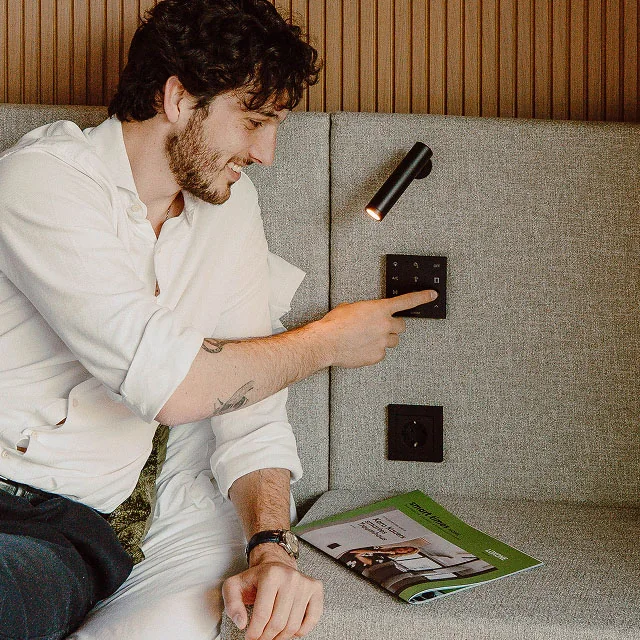
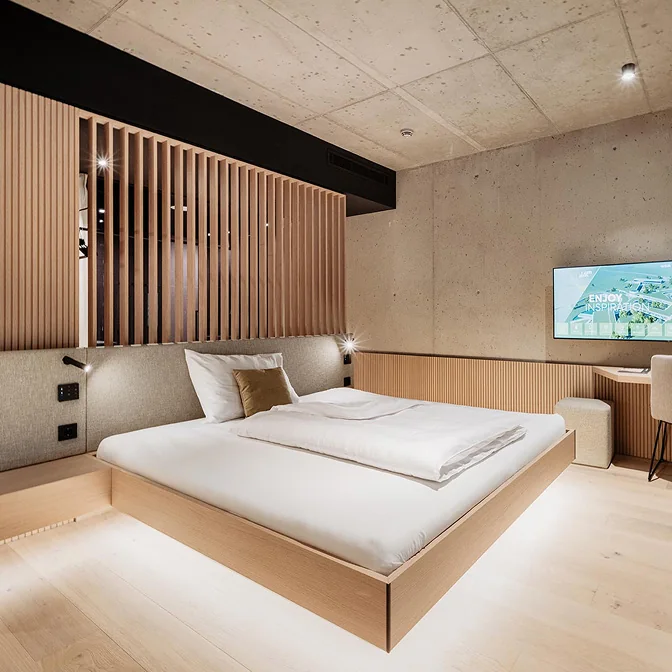
3 images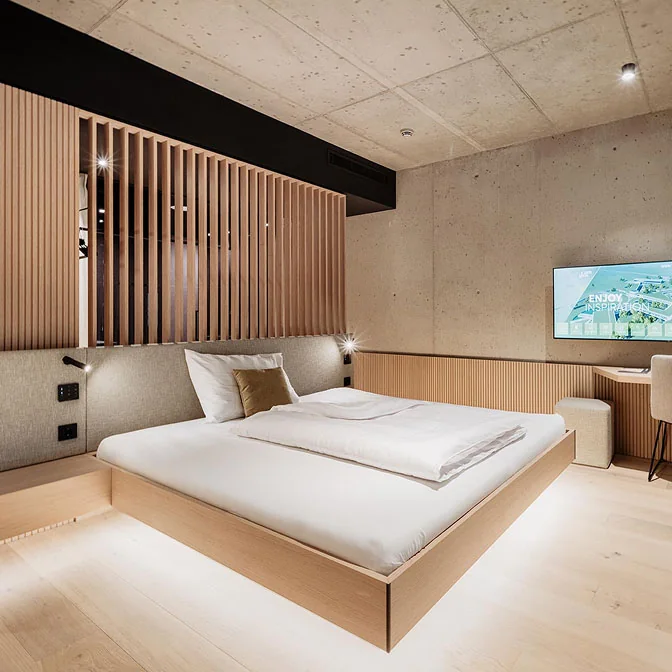
Frequently asked
01Do we need a room controller in every room?
For a hotel with lighting, HVAC, shading and access in each room, a local controller is the practical way to keep the room working independently of the central network. The alternative is a centralised design with a single point of failure.
02Can you integrate our PMS?
Usually, through the PMS API or an ODBC interface. The project confirms which events are available, whether room status can be written back, and what happens when the PMS is offline.
03How many points does a hotel room need?
It depends on the room type and the scope. Count each lighting circuit, sensor, valve, fan speed, curtain relay, door contact and service input. A suite with separate zones and motorised sheers needs more points than a standard room. The room-type schedule is the right basis, not a fixed number.
04Can we keep the existing room controllers?
Often, if they expose Modbus, an API or dry contacts. If they do not, the audit should say so before the design commits to integration.
05How do you stop guests from wasting energy?
Set comfort bands and let guests adjust within them. Unoccupied rooms widen the band, reduce ventilation and close the valves. Overrides expire when the room is empty. The aim is comfort inside an energy envelope, not a locked thermostat.
06Should room control be wired or wireless?
New-build hotels usually use wired room buses for reliability and predictable maintenance. Wireless is useful for retrofit and protected buildings. The construction programme and room type should decide.
07Does the room work during a network outage?
Yes, if the controller and local devices are specified correctly. Lighting, HVAC, shading and door functions continue locally; central reporting and PMS-driven mode changes resume when the network returns.
08What should be in the handover?
A room-type point schedule, mode matrix, PMS event map, override policy, scene list, test records and training for front desk and maintenance. The room should be repeatable, not a one-off demonstration.
Next step
Bring us the building.
Tell us the building type, systems in scope and the outcome you need. We will map the shortest path to a working system.