Comparison
DDC vs PLC — Which Controller Fits a Building
How DDC controllers and PLCs differ for HVAC and building automation: programming model, protocol support, point capacity, alarming and lifecycle.
What a DDC actually is
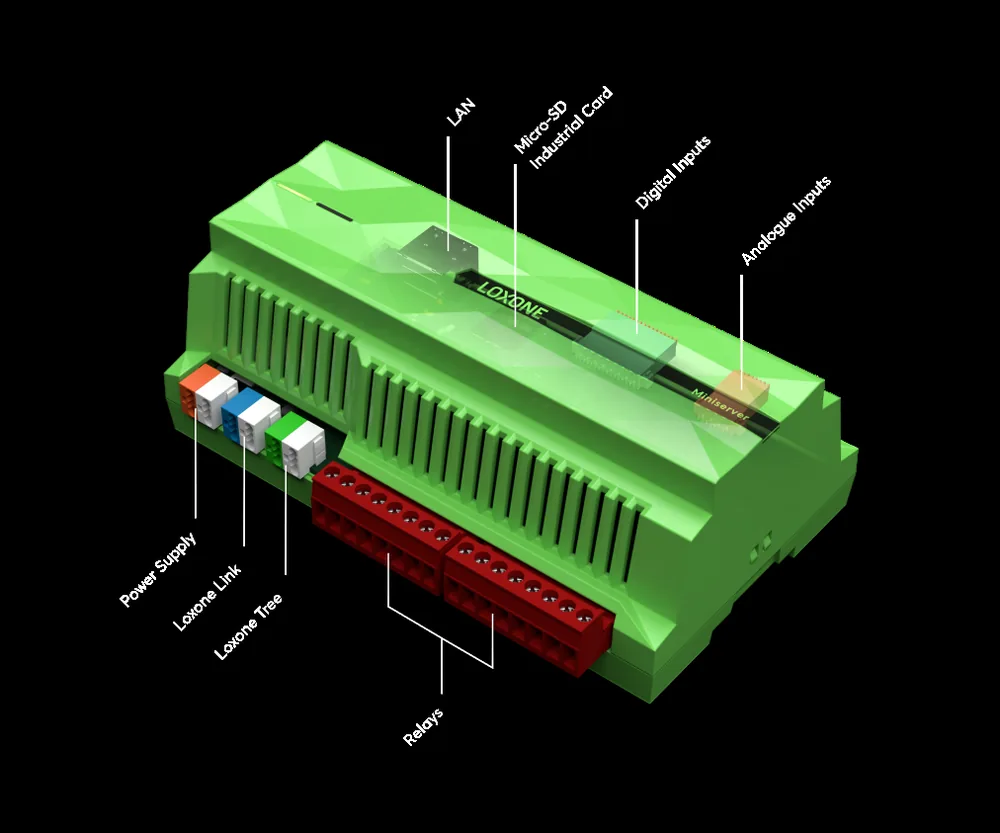
A DDC is a controller whose object model is a building. Points appear as objects with engineering units, alarm limits and a status, not as raw registers. The engineering tool ships with blocks for the sequences a building actually uses: AHU start-stop with damper and valve interlock, chiller staging, VAV pressure reset, schedule and optimum start. BACnet is native rather than bolted on, which is why a DDC can expose alarms, schedules and trends to a supervisory system without a gateway. The trade-off is that a DDC is slower and less flexible than a PLC, and vendors differ widely in how much logic the tool really gives you before you need a separate programming environment.
What a PLC actually is
A PLC is a general-purpose industrial controller built around a deterministic scan: read inputs, execute logic, write outputs, repeat. Programming follows IEC 61131-3 — ladder, function block, structured text — and the strength is high-speed interlocking, motion, process loops and rugged I/O in hot or dirty plant rooms. PLCs speak industrial networks well: Modbus, Profinet, EtherNet/IP, and BACnet on some models. What they do not give you for free is the building layer: alarm classes, schedules an operator can edit, trend history and graphics. On a building project that layer is either added as a supervision package or written, and both cost engineering time.
Where the difference actually bites
The difference shows up after handover, not in the demo. Alarm semantics: a DDC gives you alarm classes, deadbands and acknowledgement as configuration; on a PLC they are usually custom logic and a supervision database. Schedules: an operator changing opening hours should not need an engineer with a laptop. Trends: point history at the right interval, retained across a controller restart. Spares: a DDC line typically stays available for a decade or more, while industrial PLC families refresh faster. Skills: a BMS technician can read a DDC program; a PLC program may need the original integrator.
Hybrid designs that work
Hybrid is normal, not a compromise. A common split puts a PLC on the chiller plant or an industrial process — where scan speed, interlocking and vendor packages dominate — and DDC on AHUs, fan coils and room control, where the building semantics matter. The two meet at a documented protocol boundary, usually BACnet or Modbus, with one owner for the point map. The failure mode is a hybrid nobody designed: a PLC bolted on late because a package unit arrived with one, then left outside the alarm model.
How we decide on a project
We start from four questions. Does the specification already name a platform or a protocol? How many points, and how concentrated? Does the operator need to edit schedules and alarms without a programmer? And who will maintain it in five years — a BMS team, a factory maintenance team, or a third-party contractor? If the answers point to a building team and a BACnet specification, DDC is the default. If a process or a package plant dominates, PLC is the default and we design the building layer around it.
DDC and PLC side by side
10 rows| Criterion | DDC | PLC |
|---|---|---|
| Primary design intent | HVAC and building sequences | Machine, process and industrial control |
| Protocol | BACnet native, plus Modbus and KNX via gateway | Modbus, Profinet, EtherNet/IP; BACnet on some models |
| Engineering model | Pre-engineered plant blocks, point objects | IEC 61131-3 ladder, function block, structured text |
| Alarms, schedules, trends | Built into the controller and tool | Usually built in the supervision layer |
| Scan behaviour | Cyclic, seconds are acceptable | Deterministic, milliseconds matter |
| Point density per controller | High for HVAC I/O and bus points | High for discrete I/O, lower for building semantics |
| Operator graphics | Native in the BMS tool | Separate supervision software |
| Lifecycle and spares | Long, building-oriented | Family refreshes faster |
| Who maintains it | BMS technician | Controls or plant engineer |
| Typical use here | AHU, FCU, VAV, room and lighting control | Chiller plant, process lines, packaged equipment |
Typical project splits
6 rows| Scope | Usual choice | Why |
|---|---|---|
| Chiller plant, pumps, cooling towers | PLC or a packaged DDC controller | Vendor package logic and fast interlocking |
| AHU, FCU, VAV | DDC | Native BACnet objects, schedules and alarms |
| Guest rooms | Room controller chosen for the guest-room ecosystem | Interface with door lock and PMS matters more than brand |
| Electrical metering | Meters plus a Modbus gateway | Register maps are mature and stable |
| Lighting and shading | KNX or DALI | Decentralised, simple wiring, local failure |
| Process areas, laboratories | PLC | Scan speed and process interlocking |
Project images
3 images


Frequently asked
01Is a PLC cheaper than a DDC?
The hardware sometimes is; the project often is not. A PLC needs the building layer — alarms, schedules, trends, graphics — built on top, and that work is engineering time. Compare total delivered cost: controllers, supervision licences, engineering hours, commissioning and the cost of the first five years of changes, not the price list.
02Can a PLC be integrated into a BACnet BMS?
Yes, usually through a gateway or a BACnet stack on the PLC. What you get is typically a flat set of objects: values and maybe alarms, without the native scheduling and trend semantics. That is workable if the BMS owns those functions; it is painful if the PLC is expected to be the alarm source.
03Do you use PLCs at all?
Yes, where the plant demands it: chiller packages, industrial processes, and equipment that arrives with a PLC already inside. In those cases we integrate it properly rather than pretend the building layer does not exist.
04Which is better for a hotel?
DDC for the air side and the central plant, with room controllers chosen for the guest-room protocol in use. Hotels live on schedules, alarm response and guest comfort, which is exactly the layer DDC provides natively. Where a hotel uses a room-management system, the integration boundary matters more than the controller brand.
05How many points can one controller handle?
It varies by platform and by point mix: hard-wired I/O, bus devices and network points place different loads on the controller. We size against the vendor published capacity, then reserve headroom for the changes every building adds in the first two years. A controller sized to exactly the tender point list is a change order waiting to happen.
06Does this affect our specification?
Yes. If the specification says BACnet and the tender returns a PLC with a gateway, the alarm and schedule model changes. It is worth naming the required functions — alarm classes, editable schedules, trend retention — rather than only the protocol, so the comparison is like for like.
Next step
Bring us the building.
Tell us the building type, systems in scope and the outcome you need. We will map the shortest path to a working system.